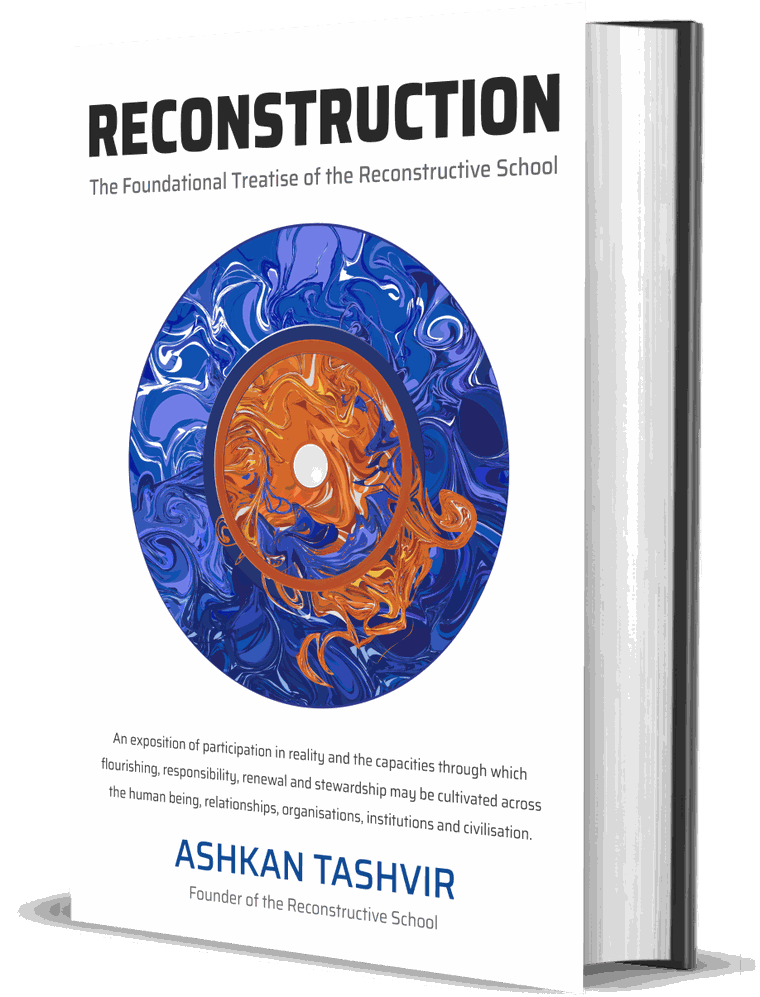
RECONSTRUCTION
RECONSTRUCTION
The Foundational Treatise of the Reconstructive School
“We have learned to alter the world faster than we have learned to participate responsibly in what our alterations produce.”
You are informed, capable and committed. And still the same difficulty keeps returning — in another team, another quarter, another relationship. Sometimes that is poor execution. At other times, the solution reached a symptom and left the conditions producing it intact.
Reconstruction by Ashkan Tashvir begins with a more fundamental question: what does it mean for human beings to participate in reality, and what makes that participation more or less adequate?

Problems That Look Separate
Some difficulties are so familiar we stop asking what kind of problem they are.
- A third report is commissioned. The disagreement is about what the numbers mean; another dashboard will not settle it.
- You want to be challenged — until it arrives with your name on the decision, and something else takes over.
- The deadline is met again, through late nights and one more problem pushed into the next cycle.
- The company grew past what it was built for. The story is still told; it is no longer felt from the inside.
- The promotion did not add tasks. It added ambiguity, consequence and responsibility — and what worked before now makes it worse.
Each is filed in a different part of life: disorientation as an information problem, incongruence as behavioural, depletion as wellbeing, emptiness as motivation, overwhelm as workload. Those descriptions are sometimes adequate.
Not every difficulty shares an origin, and no serious account reduces a human life to five categories. But some struggles that look unrelated share a structure. These five experiences are entry points into it, not definitions of it: each can appear in other forms, and any may be operating before anything feels wrong.
Participation in a World Already Underway
None of us begins with a blank page. We enter a world already shaped by languages, families, cultures and institutions, and by assumptions about what is normal and possible.
Reconstruction neither accepts that inheritance passively nor imagines we can stand outside it and build reality anew. It is responsible participation from within a reality that precedes us, exceeds us, and is nevertheless altered through our participation.
We are neither determined by the world nor standing outside it. Our lives are not simply happening around us. We participate in their formation.
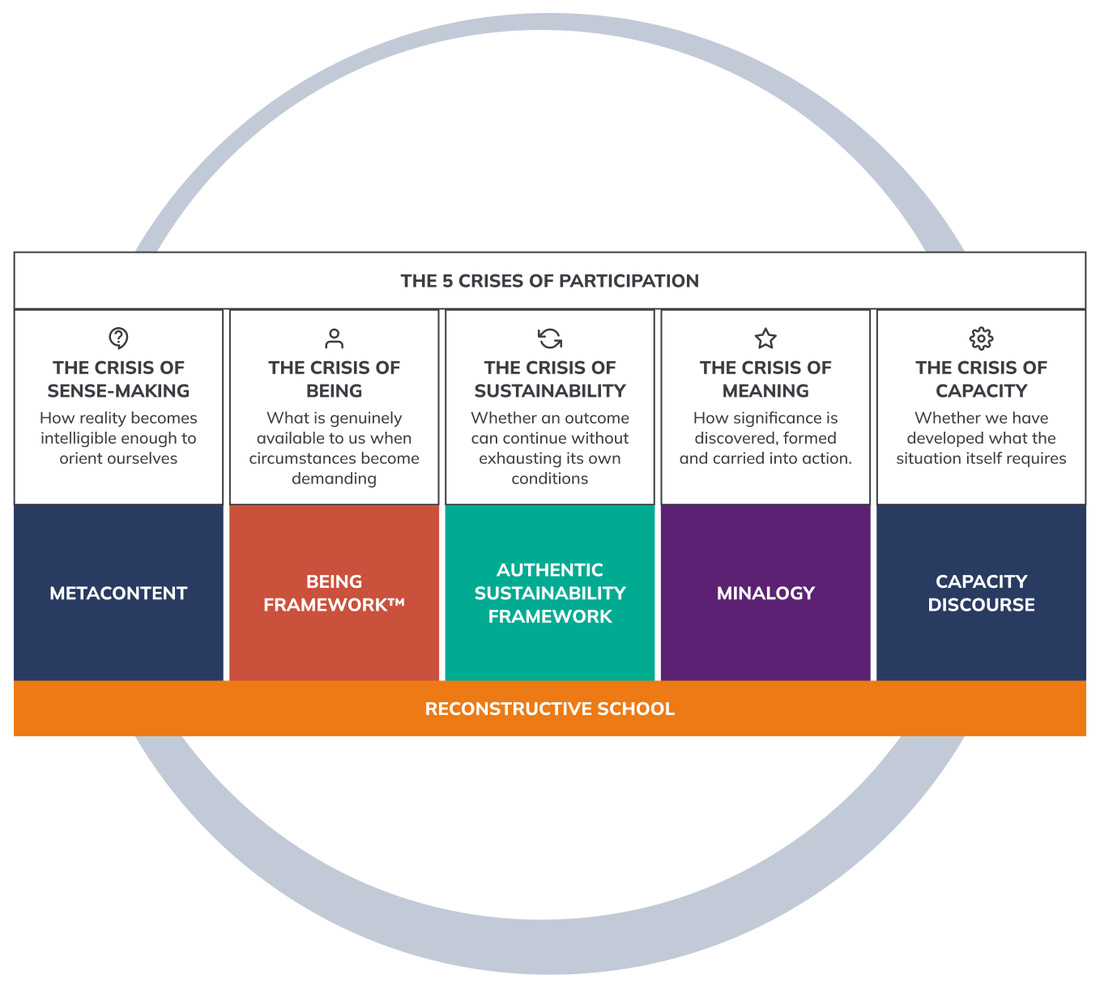
Five recurring crises mark where that participation becomes obstructed, fragmented or inadequate, each opening its own territory of inquiry.
- The Crisis of Sense-Making, met by Metacontent and the Nested Theory of Sense-Making.
- The Crisis of Being, met by the Being Framework™.
- The Crisis of Sustainability, met by the Authentic Sustainability Framework.
- The Crisis of Meaning, met by Minalogy.
- The Crisis of Capacity, met by the reconstructive account of Capacity.

Five Bodies of Response, One Architecture
Five distinct responses. One architecture. Not five tools applied mechanically to five symptoms: each supports, deepens and constrains the others.
Better sense-making does not guarantee a way of Being capable of acting on it. Capacity can be developed in service of outcomes that should never have been pursued.
Sustainability asks whether an outcome can keep being produced without consuming its foundations. Capacity asks whether the people have developed what the situation requires. Rest will not develop capacity; resilience will not repair an unsustainable system.
This is an invitation, not a diagnosis. Recognition resolves none of these crises. It changes the questions that can be asked, the territory in which we intervene and the responses that become available.
A School More Than a Decade in the Making
The Reconstructive School is newly named. The work it consolidates is not: more than a decade of philosophical inquiry, published works, instruments and practical application, refined piece by piece.
Three are already published: Metacontent, the Being Framework™ and the Authentic Sustainability Framework through Sustainabilism. Capacity follows in 2027, Minalogy thereafter. Reconstruction brings all five into one architecture.
Following the Symptom: Why This Book Matters
Our power to intervene has grown faster than our ability to discern what should be changed, what deserves to be preserved, or what human beings must become capable of holding.
Reconstruction does not ask you to look past what you are experiencing. It offers a way to follow the symptom to the conditions producing it, situating five bodies of work within one architecture.
For those who sense that the difficulties in their lives, teams and institutions are connected rather than separate, Reconstruction offers both a foundation and a way forward.
Join the global launch of Reconstruction
Connect with Ashkan
Connect with Ashkan
Ready to go deeper? Here are the best ways to get involved, start your journey, and connect with our community.
See all our upcoming speaking events and workshops. www.engenesis.com/events
Browse eventsConnect with me at ashkan.engenesis.com to access my latest articles, videos and other content
follow on engenesisFollow me on LinkedIn at https://www.linkedin.com/in/tashvir.
Follow on linkedinTo learn more about my other projects and interests, visit www.ashkantashvir.com.
connect